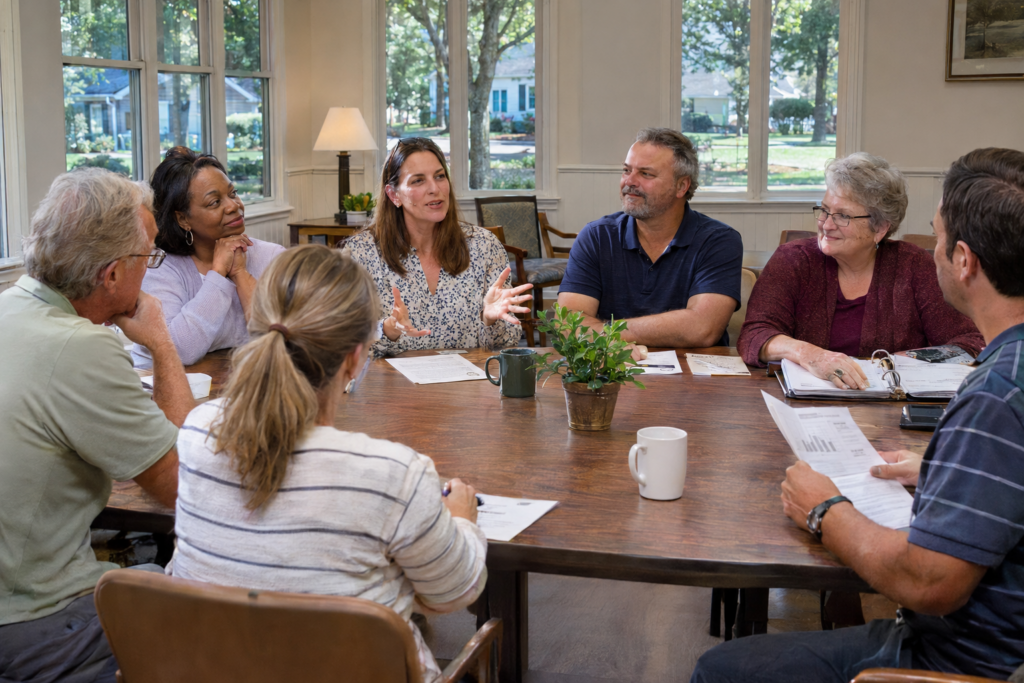
The meeting starts at 6:30. There are five items on the agenda. Someone says, “We should be out of here in an hour.”
At 8:47, the room is debating a shrub.
Not the landscaping contract. Not the annual budget. One shrub, near the entrance, that may or may not have been taller in 2019.
Welcome to the HOA meeting: a place where neighbors volunteer their evening to make the community better, and occasionally leave knowing more about mulch than they ever intended.
Whether your community is in Charlotte, Fort Mill, York County, or elsewhere in North or South Carolina, you may recognize a few of the characters below. You might even recognize yourself.
That is fine. Every one of these people has something useful to contribute. The trick is creating a meeting where those contributions lead somewhere—and everyone eventually gets to go home.
Familiar characters. Real contributions.
Every personality brings something to the table. Here’s how to make it count.
1. The Neighborhood Historian
Signature phrase:
“Well, when we first built the pool…”
The Neighborhood Historian remembers the original developer, the first landscaping company, and the exact sequence of events that led to the Great Mailbox Disagreement.
They may have a binder. The binder may have tabs. Somewhere in that binder is the answer to a question the current board has spent six months asking.
This person is valuable. Institutional knowledge can walk out the door whenever a board member moves or steps down. The Historian can explain why an earlier project failed, where a drainage problem keeps returning, or why the board should read that vendor proposal twice.
The challenge comes when background becomes the entire meeting.
Keep the value, shorten the detour:
Ask which part of the history affects today’s decision. Invite them to share supporting records with management so useful knowledge becomes part of the association’s files.
A helpful redirect: “That context helps. What should we do differently this time?”
2. The “One Quick Question” Neighbor
Signature phrase:
“Before we move on, just one quick question.”
There are three subjects in the question. One concerns a streetlight. One concerns a dog. The third requires an answer from a contractor who is not present and may currently be fishing.
The question is sincere. “Quick” was an optimistic estimate.
People bring issues to meetings because they want answers. Sometimes they have already tried another channel and received nothing useful. When that happens, the meeting becomes the place where every unresolved concern finally arrives.
Make the next step visible:
During the appropriate comment period, identify the issue, what needs to be checked, and who will follow up. Avoid promising an answer that the board does not have enough information to give.
“Management will check the work order and update you by Friday” is more useful than ten minutes of speculation—provided someone actually delivers that update.
If the same questions return every month, look at the follow-through between meetings.
3. The Budget Hawk
Signature phrase:
“What exactly are we getting for that money?”
The Budget Hawk has found a line item. It is $47 higher than last month. They would like to discuss it.
Before anyone rolls their eyes, remember: this is the community’s money. Someone should be reading the financial reports closely.
Careful questions can reveal a duplicate charge, an unexplained increase, or a service the association no longer needs. The challenge is keeping the level of discussion proportionate to the decision.
A meeting can spend twenty minutes on a small office expense and then rush through a major maintenance proposal because everyone is tired.
Give the numbers context:
Provide financial information in advance, explain significant variances, and invite detailed questions early enough to research them. During the meeting, give major costs, cash needs, and upcoming obligations the attention they deserve.
The $47 question can still get an answer. It does not need to become the evening’s keynote presentation.
4. The Amenities Visionary
Signature phrase:
“You know what this neighborhood really needs?”
A pickleball court. A dog park. A community garden. Better entrance lighting. Possibly all four, connected by a walking trail.
Every community benefits from someone who sees possibilities. Without that energy, the board can spend every meeting repairing yesterday and never discussing tomorrow.
But an exciting idea can turn a routine meeting into an unplanned design workshop. Suddenly twelve people are selecting pergola colors before anyone knows whether there is space for a pergola.
Give the idea a manageable first step:
Ask for a short concept covering the proposed location, rough installation cost, ongoing upkeep, likely community interest, and approvals that would need to be checked.
The first decision might simply be whether to investigate feasibility. Furniture selection can wait until the project exists somewhere other than our imaginations.
5. The Screenshot Researcher
Signature phrase:
“I looked it up, and it says…”
Their phone contains a screenshot of a rule, a forum discussion, an article, or something a person in another neighborhood said with tremendous confidence.
Sometimes they have found exactly the right information. Sometimes the article concerns a condominium in California, was written several years ago, and answers a different question.
The effort is useful. The source still needs checking.
Turn research into verification:
Ask for the original link or document and identify whether it applies to this association and this issue. For questions about legal authority or procedure, check the governing documents and applicable law, involving association counsel when needed.
North Carolina and South Carolina communities should not assume the same rule applies simply because they share a state line—or a search result.
“Let’s verify that before acting” is a perfectly reasonable response. Confidence is helpful. A relevant source is better.
6. The Quiet Observer
Signature phrase:
Usually nothing—until they ask the most useful question of the night.
The Quiet Observer has been listening while everyone else discusses whether the replacement fence should be black or dark bronze.
Then they ask, “Do these proposals include removing the old fence?”
Silence. Papers shuffle. Excellent question.
A meeting can accidentally reward whoever speaks fastest or longest. That does not mean those are the only people with something to add.
Leave room for another perspective:
The chair can pause during board deliberations and invite directors who have not spoken to contribute. During homeowner participation, use a clear, fair process that gives more people a chance to be heard, consistent with applicable requirements.
The goal is to make participation easier without putting anyone on the spot. A few seconds of silence can produce a better answer than another five minutes of overlapping conversation.
7. The Accidental Full-Time Volunteer
Signature phrase:
“I’ll just take care of it.”
They joined the board to help their neighborhood. Somehow, they are now coordinating the landscaper, answering pool-access questions, comparing insurance documents, and receiving photos of trash cans during dinner.
They are also the person who knows where the clubhouse key is.
There is always a clubhouse key.
This person keeps things moving, but a community becomes vulnerable when too much information and responsibility sit with one volunteer. What happens when they go on vacation, get sick, or decide they would like their evenings back?
Assign work deliberately:
End each action item with a named person responsible, a next step, and a follow-up date. Match assignments to the board’s role, committee responsibilities, and management agreement. Keep essential records and access information where authorized successors can find them securely.
“Someone will handle it” often means this person will handle it. Again.
How to run a productive HOA meeting with all seven in the room
You do not need a neighborhood full of identical personalities. You need a process that makes good use of different ones.
Start by identifying the type of meeting. A board business meeting, an annual membership meeting, and an informal town hall have different purposes. Notice, participation, quorum, and voting requirements can differ too. Build the format around the applicable rules and your association’s documents.
For the meeting itself, a few habits help:
Label agenda items as an update, discussion, or decision
Helps people understand what the group needs to accomplish
Send supporting information in advance
Gives participants time to review rather than read everything aloud
Explain how homeowner questions will be handled
Makes participation more predictable and fair
Set realistic time targets
Encourages focus while allowing important issues the time they need
Record follow-up assignments separately from formal minutes
Makes unfinished work easier to track without treating an action list as a substitute for minutes
Report back on previous assignments
Shows whether discussion is producing results
The Community Associations Institute’s guidance on getting more out of board meetings also encourages productive participation and recognizes that boards may need to research concerns rather than resolve them immediately.
Structure should help people be heard and help the association conduct business. It should not become an excuse to dismiss a difficult question.
The real test happens after everyone leaves
A lively meeting is not necessarily a bad meeting. Neighbors can disagree, ask hard questions, and still accomplish something useful.
The more telling question is what happens afterward.
Does the contractor get contacted? Does the homeowner receive an answer? Does the board get the information it requested? Or will everyone return next month for another episode of the same discussion?
At Blueridge Management Group, our HOA management services in North Carolina and South Carolina include board meeting preparation and facilitation, financial reporting, vendor coordination, and homeowner communication.
If your board’s meetings keep circling the same unfinished business, talk with Blueridge about your community’s management needs.
Your neighbors can keep their personalities. The shrub discussion can have an ending.